This was a day of contrasting altitudes. But it did give us a well-rounded sense of the topography and historical context of Jerusalem, from David's time to the present.
We tried to go up the Temple Mount first thing this morning but the line was too long. So we started walking at the Jaffa Gate and made our way to Mt. Zion. We visited the Upper Room, site of the last Supper and Pentecost. We then followed along Mt. Zion to Caiaphas' House. This was the place where Jesus was tried before the Sanhedrin and where Peter denied the Lord. In the jail, a pit in the basement of the home, we had Martin (father of an English family that has been traveling with us since Tiberius) read Psalm 88. It gave a solemn reminder of how the Lord may have felt that night.
Shlome our bus driver then delivered us to the top of the Mt. Of Olives for the stunning view of the Old City. Walking down the Palm Sunday trail we could hear the sounds of "Blessed is He who comes in the Name of the Lord." Following a visit to the Garden of Gethsemane and the Church of All Nations, we spent some quiet time in a private garden of olive trees nearby. We took a few minutes to review the night of the arrest from the last supper on Mt. Zion, to the arrest, to the trial at Caiaphas' house. Everyone was then left to their own thoughts in the quiet of the garden.
Following lunch at Ramat Rachel, we headed for the City of David. So much has been done to this site over the past ten years. We went down into the city, hearing about the archeological finds that affirm the Davidic dynasty. We then made our way along the ancient water system and sewage tunnel all the way from the Pool of Siloam to the Southern Wall of the Old City along the Cheesemaker Valley. It was a long, sometimes tight, sometimes damp journey. But it gave us a real sense of walking along the length of the city of Jesus' day.
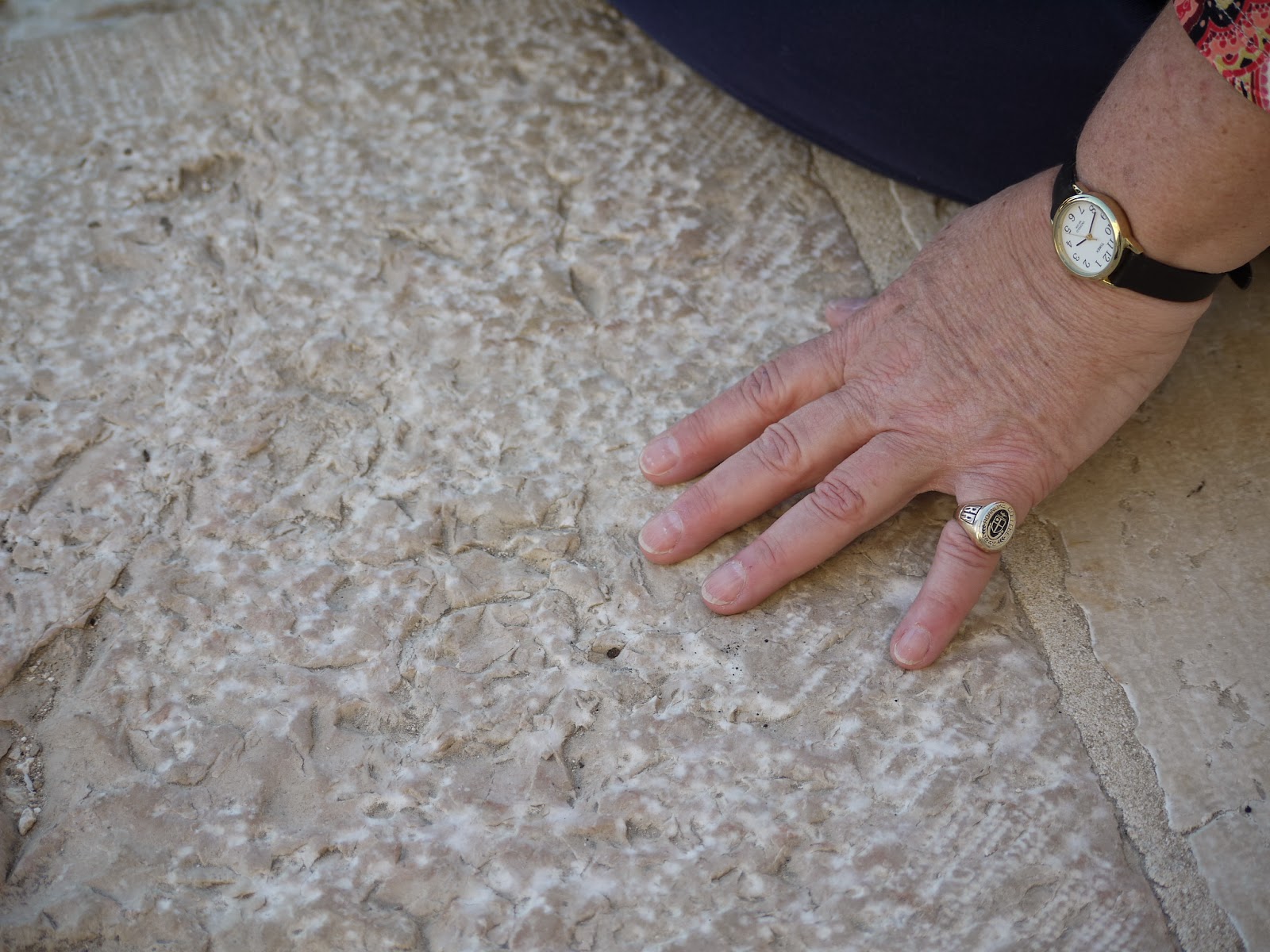
We ended our day sitting on the same steps that Jesus sat on when He was twelve and was speaking to the Rabbis the time His parents left Him. It was an amazing way to end our long and fruitful day.
Here are some visual reminders.
Wednesday, February 19, 2014
Tuesday, February 18, 2014
Up To Jerusalem
We exited the Galilee this morning and headed west. First stop: the home town of Jesus, Nazareth. A small Jewish village in Jesus' day, it is now a sprawling Arab town of thousands. We made our way through the old market area to the first century synagogue. Randy read the account from Luke 4 about Jesus reading from Isaiah 61. Jesus told them that non-Jews were responding but they were not and they tried to stone Him. We saw the precipice where they took Him as we left town and headed for Megiddo.
This ancient city with 25 distinct layers of civilization stands at the crossroads of the Via Maris and the King's Highway. Two very distinctive parts of this city are the horse stables with rock mangers and the water system. Probably under King Ahab, they disguised the spring at the edge of the hill and dug through solid bedrock in from the edge and straight down in the center of the city. It was 183 steps down and probably another 80 back up to walk along this water system. Another impressive thing from Megiddo is the ability to look across the Jezreel Valley to see Mt. Tabor, site of Barak's defeat of Sisera; the area in the valley where Allenby's defeated the Turks in the First World War; and the location of the final battle of all time here at Har Megiddo or Armageddon.
Now we crossed over and climbed Mt. Carmel. Elijah's defeat of the prophets of Baal here and the coming of rain after 3 years are both a big deal. We viewed the whole Jezreel Valley from here, from Mt. Tabor to Afula; from the area of the village of Nain, to the Mediterranean Sea. It was amazing.
We then descended to sea level once again to visit the port of Caesarea. Built by Herod this magnificent city was once a jewel on the Mediterranean. We view a film that showed its history from Herod until today. We then walked the length of the city from the theater to the crusader fortress. It was impressive. We also stopped in front of the aqueduct that brought water from springs in the Carmel range several miles away.
One of the more moving events of the day was coming up into Jerusalem as the song "The Holy City" was playing and we sang along. It is good to be home in Jerusalem. Tomorrow we begin to explore its wonders.
This ancient city with 25 distinct layers of civilization stands at the crossroads of the Via Maris and the King's Highway. Two very distinctive parts of this city are the horse stables with rock mangers and the water system. Probably under King Ahab, they disguised the spring at the edge of the hill and dug through solid bedrock in from the edge and straight down in the center of the city. It was 183 steps down and probably another 80 back up to walk along this water system. Another impressive thing from Megiddo is the ability to look across the Jezreel Valley to see Mt. Tabor, site of Barak's defeat of Sisera; the area in the valley where Allenby's defeated the Turks in the First World War; and the location of the final battle of all time here at Har Megiddo or Armageddon.
Now we crossed over and climbed Mt. Carmel. Elijah's defeat of the prophets of Baal here and the coming of rain after 3 years are both a big deal. We viewed the whole Jezreel Valley from here, from Mt. Tabor to Afula; from the area of the village of Nain, to the Mediterranean Sea. It was amazing.
We then descended to sea level once again to visit the port of Caesarea. Built by Herod this magnificent city was once a jewel on the Mediterranean. We view a film that showed its history from Herod until today. We then walked the length of the city from the theater to the crusader fortress. It was impressive. We also stopped in front of the aqueduct that brought water from springs in the Carmel range several miles away.
One of the more moving events of the day was coming up into Jerusalem as the song "The Holy City" was playing and we sang along. It is good to be home in Jerusalem. Tomorrow we begin to explore its wonders.
Monday, February 17, 2014
Books, Borders and Beauty
The morning sunrise over the Golan Heights was amazing (according to the few who were out there to see it)! We parted this morning for our tour of the Golan Heights and some of its places of significance. First stop, Hazor HaGelilit, hometown of Honi the Circlemaker. In Mark Batterson's book by the title The Circlemaker, Honi is a man of prayer who is asked to pray for rain during a time of extreme drought. I suggest you get the book to read his story. We visited his tomb.
After a stop at the Naot shoe factory, we moved on to Tel Dan, the primary headwaters for the Jordan River. This lush park area is also the northern city of Dan once visited by Abraham; ruled by Jeroboam and destroyed by the Assyrians. The gate of Abraham from around 2000 BC was found and is visible, including arches. The gate of Jeroboam is here and we can also see the Fortress of Nimrod, a 12th century fortification in the distance. That means there is over a 3000 years of history readily available right before our eyes. We also stood on the Lebanese border at the back of the tel. That is one of two of the borders we will see today.
Caesarea Philippi was next. A pagan city, also called Banias, It was near here that Peter made his great profession of faith that Jesus was the Lord or Messiah. It was also near here on an extension of the hill we were looking at where God made His covenant with Abraham. We also believe that Jesus took his disciples up on a "high mountain" for His transfiguration in that same area. That high mountain is known as Mount Hermon.
We ate in a Druze village. Wonderful falafel. Then on to cafe in the sky. This bunker saw a tremendous level of action in the first few days of the Yom Kippur war. It was cold up there. We looked over into Syria and heard the boom and felt the concussion of a shell. It was an Israeli tank brigade on maneuvers on a range just over the hill from us. No problem.
We traveled south along the eastern side of the Sea of Galilee, stopping at an overlook directly across from Tiberius. What an amazing view. Time for another group photo. We then ended our day closer to the lake, stopping near Kurzi, the area where Jesus cast the demons into the pigs. We stood on the cliff where this likely took place.
Tomorrow, we follow the Via Maris and find our way up into Jerusalem.
After a stop at the Naot shoe factory, we moved on to Tel Dan, the primary headwaters for the Jordan River. This lush park area is also the northern city of Dan once visited by Abraham; ruled by Jeroboam and destroyed by the Assyrians. The gate of Abraham from around 2000 BC was found and is visible, including arches. The gate of Jeroboam is here and we can also see the Fortress of Nimrod, a 12th century fortification in the distance. That means there is over a 3000 years of history readily available right before our eyes. We also stood on the Lebanese border at the back of the tel. That is one of two of the borders we will see today.
Caesarea Philippi was next. A pagan city, also called Banias, It was near here that Peter made his great profession of faith that Jesus was the Lord or Messiah. It was also near here on an extension of the hill we were looking at where God made His covenant with Abraham. We also believe that Jesus took his disciples up on a "high mountain" for His transfiguration in that same area. That high mountain is known as Mount Hermon.
We ate in a Druze village. Wonderful falafel. Then on to cafe in the sky. This bunker saw a tremendous level of action in the first few days of the Yom Kippur war. It was cold up there. We looked over into Syria and heard the boom and felt the concussion of a shell. It was an Israeli tank brigade on maneuvers on a range just over the hill from us. No problem.
We traveled south along the eastern side of the Sea of Galilee, stopping at an overlook directly across from Tiberius. What an amazing view. Time for another group photo. We then ended our day closer to the lake, stopping near Kurzi, the area where Jesus cast the demons into the pigs. We stood on the cliff where this likely took place.
Tomorrow, we follow the Via Maris and find our way up into Jerusalem.
Sunday, February 16, 2014
A Day Of Emotions
I believe there is a consensus that the group likes the Scots Hotel. Once a hospital that treated both Jews and Arabs, it is run today by a group from Scotland and is one of the best hotels in the country. We began our day by walking, not riding. We traveled a few blocks down to the docks to embark on a ride on the Sea of Galilee. The calm water made us question how such a storm could happen that would swamp a boat. But Nir told a story how the sea changed in a matter of minutes when he was out there one time. We read from the Scriptures, sang, and prayed. From here we would see the geography of the majority of Jesus' ministry. Capernaum directly north; Bethsaida to the north and east across the Jordan River; the Mount of Beatitudes; Migdal, the home of Mary Magdalene. Kursi, where the demoniac was set free was to our east. It all happened right in front of us. It was a moment for quiet reflection.
We visited the ancient boat at Ginosar that was found in the 1980's. It dated to the first century and gave us insight into the fishing boats Peter and Andrew, James and John were using. It was then on to the Mount of Beatitudes. This was were Jesus preached the Sermon on the Mount and fed the 5000. After reading the Scriptures and making a few comments, we spent time alone meditating and taking in the place. It was humbling and stirred our souls.
We then made our way to Korazim, one of the three cursed cities. Jesus served as a traveling Rabbi to Korazim, Capernaum and Bethsaida. He did many miracles in these cities. But because they failed to repent He cursed them and all three are simply piles of rock today. The dark, volcanic basalt rock was definitely different than the limestone we have seen other places.
Tabgha was next. The place on the shore where Jesus made breakfast for the disciples after He resurrected and they went fishing. It was here that Jesus also addressed Peter by asking him three times, "Peter, do you love me?"
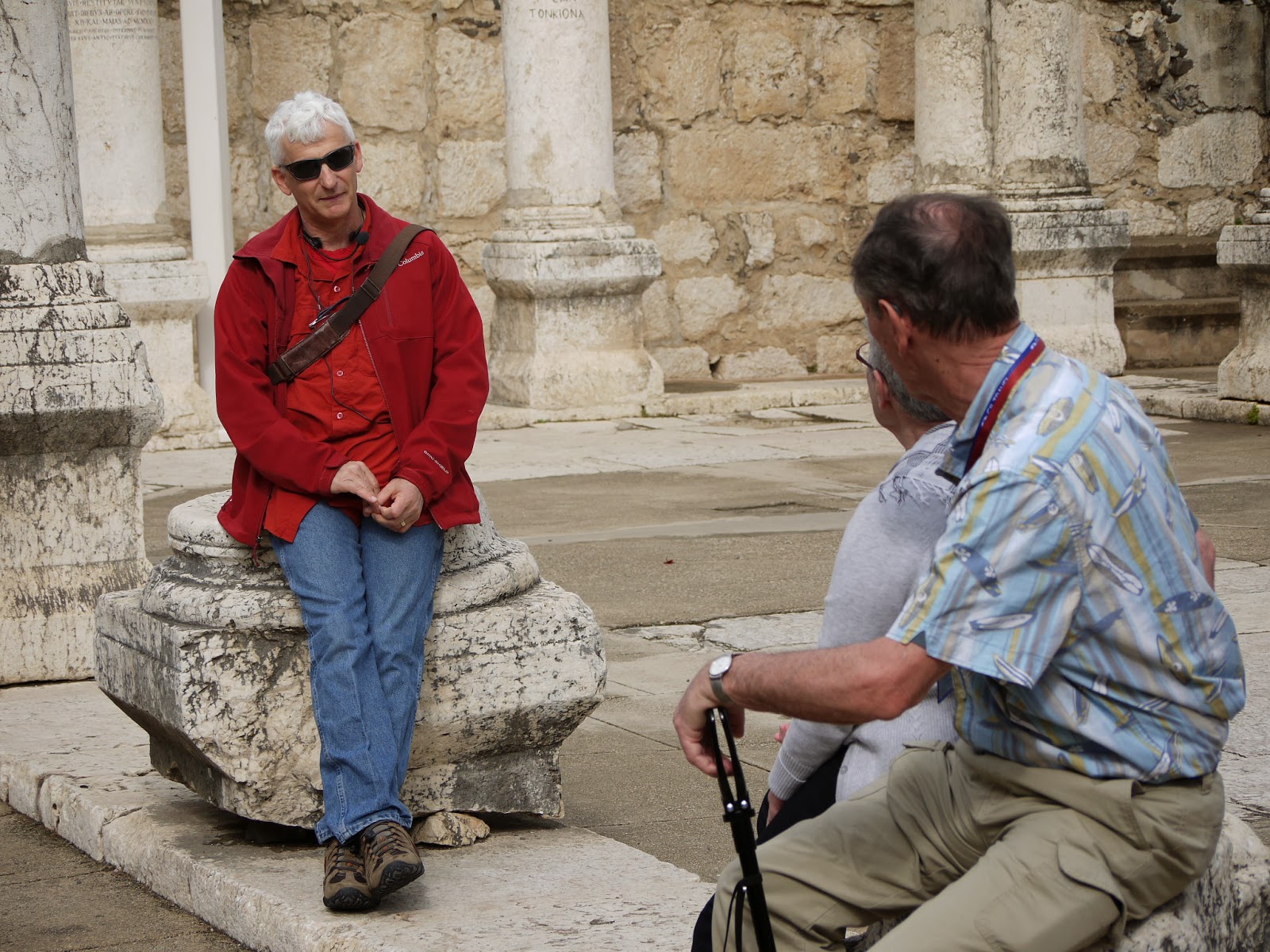
Capernaum was the headquarters for Jesus' ministry. He taught often here. He healed Peter's mother-in-law here. He stayed here most of the three years He did His ministry. We saw the remnants of what is thought to be Peter's home underneath the Catholic chapel built overtop of it. We sat in the synagogue. We then were shown two columns that were very special. One spoke of a family by the name of Zebedee, with a son John. Names were repeated in families and it is likely this proves that this was the same family as the sons of Zebedee in the Bible. The other column was carved with a 7 candle menorah. It showed this was a Jewish town at one time.
We ended our day with 18 people being baptized. It was a moving experience as we sang Amazing Grace before and the Doxology afterwards. A short stop to visit a kibbutz that makes products from dates, including seeing a movie about its history and it was back to the Scots for another wonderful meal.
Return to Israel
It felt like coming home today. While we had an enjoyable time in Jordan, and were treated well, there was something nice about crossing the border back into Israel. And it was a joy to be joined by our friend and guide Nir Nitzan and rejoined by our bus driver Shlome.

We loaded up and headed south along the Dead Sea road to Masada. Riding up the crowded cable car, we were immediately struck by this massive fortress in the desert. Herod had it built likely to govern the perfume trade of the Nabateans from Petra to Gaza and also as a place of escape if faced with treachery. We visited the ancient storage rooms, bath house, palace area and synagogue. We saw the remnants of the ramp used by the Romans to attack the rebel Jews who fled here following the fall of Jerusalem in 70 AD. 960 people committed suicide the night before they broke through.
We then made our way to Qumran, the location where the Dead Sea Scrolls were found by a bedouin shepherd boy in 1947. They saw themselves as the "children of the light", fighting against the darkness of a corrupt priesthood in Jerusalem. They focused on the copying of the Scriptures and prayer. A complete copy of Isaiah and pieces of every other Old Testament book were found here except for Ezra and Esther. We will see these fragments later in Jerusalem.

Because our crossing took so long this morning, we only had time left for our travels up through the Jordan Valley. Before dark we did catch a glimpse of Jericho. But the blessing was that we traveled most of the way in rain. Israel has had drought conditions this winter and the water was very welcomed. We reached the Scots Hotel in Tiberius for our first night in the Galilee.
We loaded up and headed south along the Dead Sea road to Masada. Riding up the crowded cable car, we were immediately struck by this massive fortress in the desert. Herod had it built likely to govern the perfume trade of the Nabateans from Petra to Gaza and also as a place of escape if faced with treachery. We visited the ancient storage rooms, bath house, palace area and synagogue. We saw the remnants of the ramp used by the Romans to attack the rebel Jews who fled here following the fall of Jerusalem in 70 AD. 960 people committed suicide the night before they broke through.
We then made our way to Qumran, the location where the Dead Sea Scrolls were found by a bedouin shepherd boy in 1947. They saw themselves as the "children of the light", fighting against the darkness of a corrupt priesthood in Jerusalem. They focused on the copying of the Scriptures and prayer. A complete copy of Isaiah and pieces of every other Old Testament book were found here except for Ezra and Esther. We will see these fragments later in Jerusalem.
Friday, February 14, 2014
Seeing from a Different Perspective
We then traveled the short distance to Mt. Nebo. Because Moses dishonored the Lord in the desert by striking the rock in anger to get water rather than just speaking to it, he was not allowed by God to enter the Promised Land. But God did direct him to go up to this mountain and He would show him the land from here, to see it from a distance. (Deuteronomy 32:48ff) What an amazing view. The sky cooperated so that we could see houses in Jericho, the mountains around Jerusalem, the Dead Sea, and the mountains of Samaria. It gave us a different perspective and made it clear how the Israelites traveled as they would enter the land promised to Abraham. From the top of Mount Nebo to the Jordan Valley is a decent of over 4000 ft. Just ask the folks about the bus ride down!
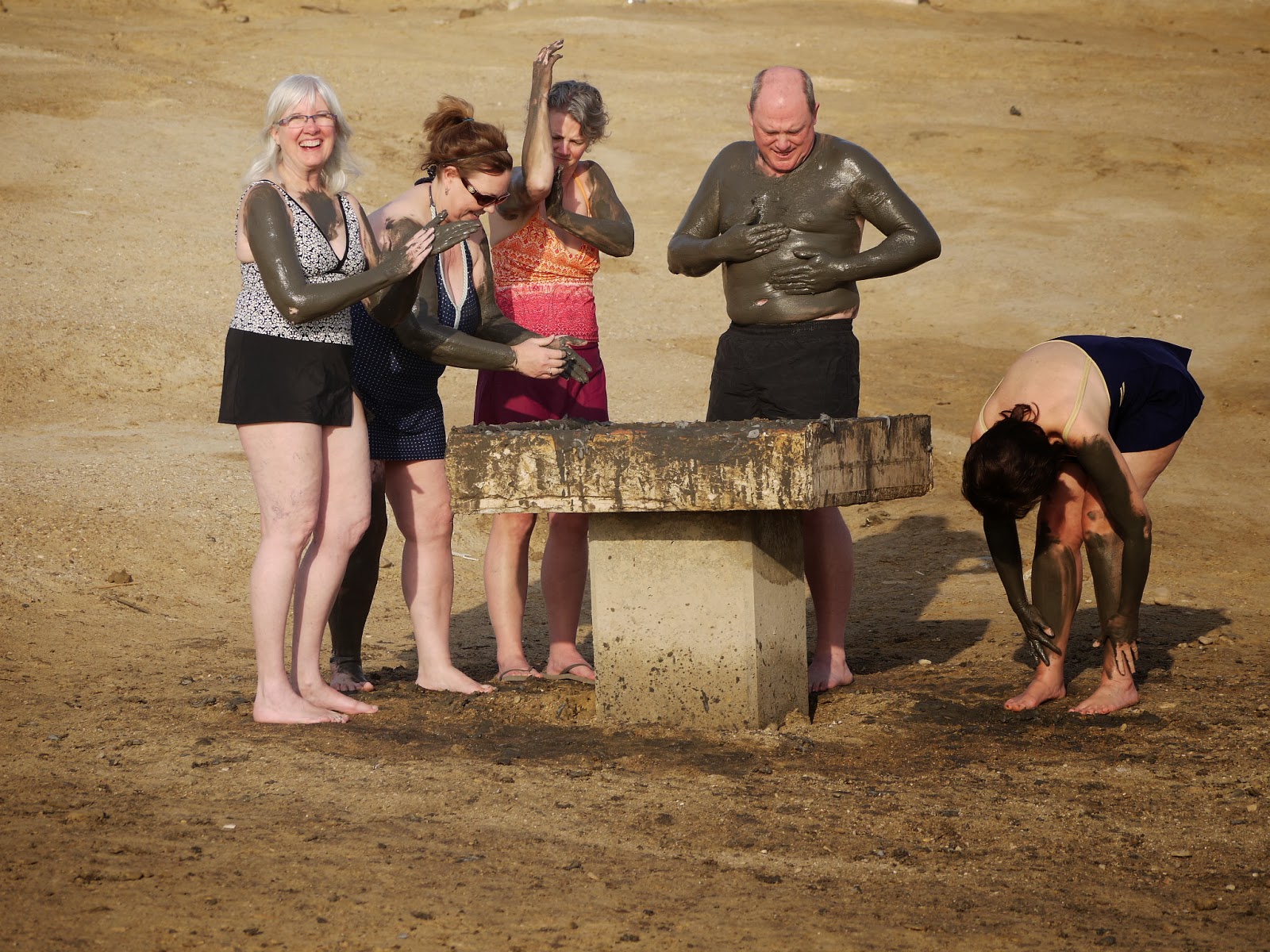
We ate lunch at a local Christian restaurant. At one point Madaba was almost a 100% Christian town. Now it is about 3% Christian. By support of the government and the royal family, Christian are free to worship and practice their faith in Jordan. The reason for the decline here is that most of the families from Madaba have moved to Amman for better work. We ended our time around Madaba by visiting a foundation that makes mosaics by employing a number of handicapped workers. They showed us the process, both old and new, of making the mosaics. Depending on the materials used, it could take up to 2-3 months to complete a project. It was then on to the Dead Sea. It had been arranged for us to use the facilities of a nice hotel and spa on the sea. We walked past the preparations for a wedding that was to take place on the beach at sunset, mudded up, and entered the water to float. Some made the full commitment; others a partial, and a few served by watching our stuff. We had a blast.
An hour drive and quick check in, clean up and dinner, and we were honored to have a new friend come and share about his ministry in Jordan. He helped us see from a different perspective about having respectful conversations with others about faith and life.
Tomorrow we cross into the land near the same place the Israelites did and meet up with our friend and guide, Nir Nitzan.
Subscribe to:
Posts (Atom)